
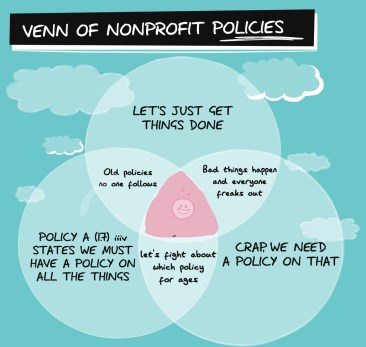
The Point of Policies: the case for writing things down
Why do non-profits need written policies? Like many things in the world of this sector, senior staff and volunteer Boards often have vague ideas about what policies are needed, why they are important, and how they should be utilized. And yet organizations seem to function, serve their communities, and even thrive with outdated, unclear, or overly legalistic policies that no one ever looks at.
It is a symptom of a common problem in our organizations – funders, governance ‘experts’, a policy-geek Board member, a new ED – someone has said policies matter, but few are clear exactly what policies are required or where to go for direction. Or the organization has fallen into the policy pit known as the Carver model or its limp offspring, the ‘Governance’ Board.
(As an aside – it’s time to move on from the Working – Governance Board binary. it isn’t helpful. No model will stop Board members from having governance obligations, no matter how engaged in operational tasks they are. And no amount of distance from operations will stop a Board from having to step in – and therefore have a handle on operations – where there is a staff leadership problem. But I think that is my next blog.)
So. Policies. As the Board Source folks say in their gi-normous Nonprofit Policy Sampler, John Tropman has a great definition of ‘policy’
…an idea that is embodied in a written document, is ratified by a legitimate authority, and serves as a guide to action.
Let’s break it down:
- An idea – No good policy comes from crisis. Or hardly ever. Usually, a crisis leads to a highly specific policy that reflects a past concern, not a strategic consideration of risks and aspirations. All policies should start with an agreement of the group about something that matters to the organization, a way they want to behave, a rule everyone needs to follow, an approach to common problems, and/or a process for managing challenges. Some are governance related, some are operational, some are about systems, some are expressions of core legal obligations of the various players. And none of them can contradict your by-laws or basic constitutional purpose.
- Embodied in a written document – If you have a policy that isn’t written down, it isn’t actually a policy, it is a practice. one way to think about the layers of how an organization functions is to consider how easy it is to change the practice:
- if you want to change it regularly and easily, keep it as a practice people are trained on and have some accountability to others (supervisor) to follow.
- If it is something that should be considered before changing, determine who needs to do the considering (see ‘legitimate authority’ below) and set it in writing as a policy
- If it is an absolute must that should be difficult to change, write it into the bylaws
- If it can’t change without fundamentally altering the reason for your organization’s existence, it should be in your constitution.
3. Ratified by a legitimate authority – this causes some confusion for many in the sector. There is often an assumption that the Board must pass all policies, but that isn’t true for a number of common operational policies. A lot depends on the size of the organization – the smaller the staff team, the more likely the Board may be helpful/need to be involved.
In a large organization (imagine 30+ staff, 5million+ budgets), The chief executive would take care of policies that guide and direct staff. the Board may want to ratify a package of HR policies to ensure commitments to a safe and positive workplace, but it isn’t mandatory if the Board has delegated legal obligation to the ED in the area of employment law. I would recommend the Board do this, because employment law is often the biggest legal risk in the organization. But it is up to the ED usually to ensure these policies are in place and followed.
In a large organization the Finance team would draft financial procedure policies around financial controls, but like HR policies the Board should prove they know about them and are confident in them by showing in the minutes they have approved them.
The Board, with the support of the ED is responsible for overarching governance policies that extend the topics not covered by the bylaws.
4. …And serves as a guide to action – here is the key to a healthy nonprofit policy environment. If the policies are relevant to your work, if they reflect the best thinking of the organization, if they are kept up to date, if they are transparent to all the key people, then they ought to form an active part of discussions and decisions. If a crisis arises, they should help, but they ought to have prevented the crisis in the first place.
I believe it is more important to have a small number of key policies that are actively utilized by decision-makers (aka everyone because lets face it, everyone makes decisions for the organization at some point) when faced with options, rather than a ton of formal and highly legalistic policies. Please download the Core Policy infographic on my Resource page.
It is also important to go through the first three things – determine the idea that needs a policy, draft a policy, and have the ratifying body consider a draft and give feedback – before you involve a lawyer. If you take ownership over the point and form of the policy, it is much more likely to actually be used a la point 4 above!

 Top 10 ways to use your Strategic Plan

